Friday, June 01, 2007

Finally in Indianapolis


INDIANAPOLIS-- After an unplanned four-hour layover in Atlanta Hartsfield, I finally got on an AirTtran Airways flight to Indiana's State Capital.

I arrived in Indianapolis about 2:45pm, and got to the Leadership Institute about 5 minutes late.

More to reflect on later as I post this evening.

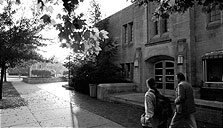
More now, this view of the IUPUI campus will have to do. Gotta go to dinner.

Kicked off AirTran for Taking Notes


ATLANTA-- It’s now 10:27 a.m. I was supposed to be almost in Indianapolis—City #6 on my SEVEN CITIES, SIX WEEKS summer tour. But, I am still in the Atlanta Hartsfield Airport for taking notes on the flight.

Sounds bizarre?

I thought so.

In these jittery post-911 days, flight crews like the employees on AirTran Airways Flight 419 have to be on the lookout for suspicious passengers.

I suppose taking copious notes about my first travel experience on AirTran in almost 10 years could be construed as suspicious.

AirTran has apologized for the inconvenience and given me a free pass for another flight. They’ve re-booked me on an afternoon flight that will get me to Indianapolis in time for the start of the Society of Professional Journalists Scripps Leadership Institute on the Indiana University-Perdue University Indianapolis campus.


But, the bigger story here is that something as harmless as taking notes might get you kicked off a flight.

Fortunately, I as a journalist did not have to surrender my notes and I don’t think I was the cause of the flight being about 10 minutes late taking off. The AirTran Airways attendant who escorted me off said the flight was held up also because they were waiting for ice.

For now, I’m happy recounting the strange experience as perhaps the most memorable event in my “Seven Cities, Six Weeks” tour.

More later.

At least this gives me time to blog about what I experienced getting into the Atlanta Airport this morning. I’ve been gathering elements for that posting.

Thursday, May 31, 2007

Bayou LaBatre, Ala.-- More than Mobile


MOBILE, Ala.-- After a l--o--n---g drive from the northernmost point of Alabama down I-65 to the southernmost point-- Mobile, to Interstate 10-- we are now in City #3 on our "Seven Cities, Six Weeks" tour.

Specifically, I was going to Alma Bryant High School where students there have received a grant from the Radio-Television News Directors Association to bring podcasting to their broadcasting program.

As the author of a soon-to-be-releaesd "Teaching with Podcasting" DVD, I wanted to use Alma Bryant as a place to pilot-test some of ideas for the DVD. Well, I got an eyeful.

First of all, I didn't realize how big the Mobile area really is.

On Sunday, I stayed in Saraland, Ala. before venturing down to Bayou LaBatre (I just learned how to spell that word)

Because of its distance from Tuscaloosa (about 3-4 hours), Mobile is one of the few cities I have only visited a couple of times-- both before I moved to Alabama.

On each of my previous visits, I was enroute to either New Orleans or Tallahassee (long story, I'll explain that one another time).

This time, I ventured well off Interstate 10 down to an area that is right in the "line of fire" so to speak (how's that for a cliche) when hurricanes come ashore.

Alma Bryant is a beautiful high school and folks there were S--O nice. I plan to make a return visit in the fall semester.

As for the rest of the Mobile area, well my second stop of the day was at the Mobile Register, where the Business Editor, K.A. Turner, gave me a quick tour of one of the nicest newspaper facilitiss in Alabama.

My photos are really bad. But, I did get an ok shot of the distribution room where all the Press-Register newspapers are assembled.


All in all, this first visit to downtown Mobile was a quick, but good one.

Later this summer-- in July-- I will go back to the area-- to Orange Beach, Ala. for the Alabama Press Association's Summer Convention. I plan to get some better shots of the newspaper building then.

City #2- Nashville, TN


NASHVILLE-- Even though Nashville is listed as one of those datelines that does not require a state abbreviation, I thought it was important to remind you that I'm in Music City.

I few years ago when I visited Indiana University, I learned there is also a Nasvhille, Indiana There is a Nashville, Indiana located in Brown County just miles from the IU main campus.

On May 5, I made the three-and-a-half hour drive from Tuscaloosa to Nashville for the Society of Professional Journalists Green Eyeshade Awards program. It's one of several opportunities we have to see some of the BEST journalism being produced.

The Green Eyeshade program is a regional competition that involves states in the Southeast.

I'll have to make a separate posting on the ceremony itself. For now, I'll share some of the sites.


The Tennessee State Capitol is one of the first sites I'll share. I didn't get a chance to go inside. But, before leaving town on Sunday, I drove downtown to see the building located on a high hill. This area was a federal fort during the period of Union occupation. The building was completed in 1859.


Also on Sunday, I attended church at Mt. Zion Baptist where Bishop Joseph Walker is the senior pastor. I've been blessed before by Bishop Walker's teaching via the Trinity Broadcasting Network.

It was a totally differenr thing to be in worship with the thousands who are members of his church, which three locations in the Nashville metropolitan area.

You can see from the sign on the church's marquee that it's a church that ministers to all of the needs of its congregants.. even those who are divorced.


After church, I briefly drove through the Vanderbilt Campus, which one of the only two SEC (Southeastern Conference) schools I had not previously visited (the other is in Oxford, Mississippi). Well, actually, I had been to Nashville closeby before-- but it was not as extensive as my trip this time.

Jackson, Miss- The Starting Point


JACKSON, Miss.-- How appropriate to begin my "Seven Cities, Six Weeks" Tour in the Mississippi State Capital. It's the place where a high-profile civil rights case is going to trial.

James Seale is being tried on federal kidnapping and conspiracy charts in the 1964 deaths of two black teens. It is refreshing to see the Clarion-Ledger taking a position on the importance of the trials on its editorial pages.

Not related to the trial, however, my experience making this journey on May 1 was to visit the campus of Jackson State University.

I am fortunate to be serving on a doctoral dissertation committee for a student at Jackson State. It's not only a chance for to see this colleague complete her terminal degree, but also a chance to visit another historically black college or university.

As a product of an HBCU (Howard U.), I have a special place in my heart for these schools that educate more African-Americans than any other institution for careers in journalism and mass communication. Today, Jackson State University has the nation's only E-Ph.D. or Executive Ph.D. program in urban higher education.

That's where I visited on May 1.


I didn't walk the grounds of the main campus. Instead, I spent most of the day at the Jake Ayers Institute for Urban Higher Education, which is in the same building as the University's TV station, TV 23.

I got to tour the facility and speak with one of the production assistants who shoots and edits local content for the station, which up until recently aired programming from the Black Family Channel.

After meeting on the JSU campus, I ventured downtown to see the Mississippi State Capitol. Unfortunately, time did not permit me to go inside to see the hub of Mississippi's state government. But, at least I know where it is -- just off Interstate 55.

City #5- Atlanta, Ga.


ATLANTA-- Tonight we end the month of May as we began—on the road. I never posted my updates from City #1, City #2 or City #3 on the Seven Cities, Six Weeks Tour. (That’s coming, I promise) But, it all began May 1.

City #5 is Atlanta, Georgia.. another state capital. That makes THREE State Capitals I’ve visited (four if you include one I drove through) within the last 30 days.

The important components of these visits are the sites, sounds and the experiences. Since I’ve lived here before, Atlanta is not really a visit. Instead, it’s a reunion.

There aren’t many sites and sounds to take in from Interstate 20, which is about all I have seen today. (We’ll see how bad morning traffic is tomorrow)

The occasion: taking a flight on AirTran Airlines or is it AirTran Airways? I’ll have to check that out later.

I usually fly either Delta or Southwest Airlines. But, this trip to the Society of Professional Journalists Scripps Leadership Institute is being funded through the SPJ Headquarters, which uses a travel agency.

These days many of us have become accustomed to air travel with electronic tickets—the ones that are e-mailed to us and we check-in online printing our own boarding passes.

Well, when you use a travel agency, you have to get a paper ticket. So, I’ll have to go through the old-fashioned check-in with my paper ticket tomorrow morning at Atlanta’s Hartsfield Airport, which just celebrated the one-year anniversary (a term that is stylistically incorrect according to the latest Associated Press Stylebook) of its newest runway.

So, greetings from Georgia’s Capital City—the former Olympic City—Atlanta!

Wednesday, May 16, 2007

City #4- Chicago- A Day At Navy Pier


CHICAGO- The 3:30 a.m. wake-up was necessary to visit the Windy City in a day and still come back to Tuscaloosa.

We landed at Midway Airport by just about 8:15 a.m.

The cab ride from Midway to Navy Pier was a not a short (or a cheap) one-- a $30 one at that.

And than, there's Navy Pier- HUGE- JUST HUGE! I made the mistake of coming in the wrong end of this attraction and we walked and we walked and we walked all the way to the other end of the Pier-- the more scenic end where 500+ people were already in place for the Adobe CS3 Creative License Conference.

This above photo was taken from the other side of the room where more than 500 people turned for the first in a series of one day conferences. The photographer, Terry White, wrote more about today's conference on his blog.

He was the main presenter at the conference, about which I'll write more later.

Tuesday, May 15, 2007

Summer Travel Log Begins


Even though it was TWO weeks ago today that I began a seven-city swing to places in the eastern United States, I am just getting around to starting my online journal of what I learned from each of these places.

As the rough artwork depicts-- I'm calling this "SEVEN CITIES, Six Weeks" as a way to tie together what I expect will be a long series of postings.

My goal is to present in a multimedia fashion, a series of reports, updates, lessons learned, reflections, etc on my experiences in the places to which I travel between May 1 and June 23, 2007. (Yes, technically that's a slight bit over six week-- but you get the picture).

Starting on Tuesday May 1, I visited the Westernmost city on the tour-- Jackson, Mississippi. That was followed on May 5 with a stop in Nashville, Tennessee. Then on Sunday May 6, I arrived in Mobile, Alabama.

Tomorrow, May 16, I will be back on the road again for a one-day excursion to the Windy City of Chicago, which will be followed roughly two weeks from now to the Indiana State Capital-- Indianapolis on June 1.

In between Chicago and Indianapolis, I will make a very brief stop in the Georgia capital city of Atlanta.

The Seventh and final city on the schedule is Columbia, South Carolina. Yes, there will be worthwhile points in between to mention. My datelines will let you know the places from which I was filing.

You'll notice in the list of stops are visit state capitals. I hope to visit the actual state capitol in the state capital while I am there.

The experience of blogging over this period of time is teaching me just how difficult it is to keep an online journal-- keep it up, update it and present different content that is interesting and compelling to read and enjoy.

Why do we do these travel logs? What is the benefit of multimedia journalism? And, what does providing this kind of insight do to the reporting experience? Those are some the questions I hope to answer as I go along this personal summer journey.

On some legs of this trip, I'll have postings with a timeline to share as I make the more interesting aspects of the trip real -- while on others it will be a traditional journalistic endeavor of writing a story that has an interesting hook or compelling lead or exciting quotation.

The dates of the postings may not necessarily correspond to the day the trip was taken. That's all a product of where I am and the nature of the computer access I have along the way.

Well we have an early start tomorrow-- with a 6:40 flight from Birmingham. So, we'll call it a night.

Friday, March 30, 2007

Watching the Web from the newsroom


GAINESVILLE, Fla.-- It's been a while since I've posted ANYTHING on this Weblog. Guess a month has passed. Well, let's see spring break -- travel back home to Virginia, back to Tuscaloosa and a big research paper deadline -- which is this weekend-- those activities will kind of eat up the time for blogging.

Even as I finish up the research paper(s), it's great to be back in the Sunshine State of Florida. I've posted a more extensive DAY 1 update on the Society of Professional Journalists Conference on my COMJ Exchange Blog. But, I thought I'd show off this giant HD monitor that I saw in the newsroom of The Gainesville Sun.

Perhaps it is a sign of the times as reporters and editors at the 50,000 circ paper monitor their paper's Web site and several others like the Arizona Republic's site -- which integrates the converged media efforts of Gannett's highly successful daily in Arizona and its Phoenix TV station, KPNX- 12 News.

More fun stuff from Gainesville as we visit the University of Florida campus tomorrow morning.

Sunday, February 25, 2007

Experiencing Northern Nevada


RENO, Nev-- As I've posted over on my comjexchange blog, I'm in Reno, Nevada today finishing up a four-day visit to the nothern part of the silver state.

This photo hardly tells the story.

More later.

Saturday, February 17, 2007

George Curry heads to Tuscalooosa


After being here in Tuscaloosa for four years, I am finally going to meet one of the town’s most well-known native sons.

George Curry, editor of the now-defunct Emerge magazine, is coming back to speak at the University of Alabama on Monday.

I’ll say this particular visit is one I had hoped we would have years ago when George and I exchanged e-mails right after I moved here from the University of Georgia.

Curry was candid about the history of Tuscaloosa and the lines that in the past have sometimes divided its residents.

His insight gave me a context to understand the recent debates over the location of the new Central High School.

In many ways, Curry and I have had similar paths—not just as journalists or black men who’ve lived (and I assumed loved) being in the nation’s capital. And, not JUST because we both have the same first name.

Back in his days at the St. Louis Post Dispatch, Curry was instrumental in reaching back to high schools. He was the founding director of the St. Louis Minority Journalism Workshop. He subsequently started a similar workshop in Washington, DC.

I frequently sing the praises of these Dow Jones Newspaper Fund workshops because of what I know they do for diversity in the newsroom and specifically for the role one played in my own life.

Of course, just yesterday, I commented on the recent court decision involving the Dow Jones Fund’s use of name “minority” in those workshop names.

Curry realized as I have that as African-American journalists, we have a responsibility that goes far beyond getting the story or putting out a newspaper or television show.

He remembers the role journalists can and should have in making a difference—a lasting difference.

Just ask one of my home girls, Kemba Smith, whose minor role in a drug ring while at Hampton University landed her in prison because of the federal government’s “mandatory minimum” drug policy. With a brother at Hampton University, this story was one in which I had a lot invested. The Smiths were a big part of our community in Richmond.

I could go on and on about why George Curry is one of the best in the business.
In the pre-Viacom days when Black Entertainment Television was owned and run by Bob Johnson, there was a program called “Lead Story,” that featured African-American journalists talking about issues in the news for the week.

Seeing Curry, who now runs the National Newspaper Publishers Association and BlackPressUSA.com, on that show was how I got to know this native of Tuscaloosa.

After Black Entertainment Television became part of Viacom, it was not long before the public affairs programs like Lead Story were canceled.

Richard Prince’s JOURNAL-ISMS recounts more about what happened.

Curry, in fact, commented on the decision to kill not only Lead Story, but also two other public affairs programs in a story on his NNPA News Service.

“An African-American company gains a considerable amount of capital when it sells out to a powerful conglomerate,” said Curry, who was a panelist on “Lead Story” for more than seven years. “But it also loses something important. Regardless of how BET tries to spin it, the loss of these important programs represents a major setback for the Black community.”

Curry has tried to resurrect Emerge magazine, which went under in 2000. I hope on Monday we’ll learn more about those efforts and what he’s doing at BlackPressUSA.com.

Friday, February 16, 2007

Fed Court: Open up minority journalism workshops

It is official: if you’re white and can prove that your race is the only reason you’re not being allowed to take part in a summer journalism program at an academic institution, you can sue and force the institution to admit you.

Yes, the way I’ve stated this is a little inflammatory. But, for good reason. Fortunately, civil rights laws don’t allow discrimination based on one’s race in any scenario.

Last summer, Virginia Commonwealth University clearly erred in disinviting a white student who had been admitted to its Urban Journalism Workshop allegedly because the workshop organizers learned she was not a minority student. Read more about the case in this story from the Commonwealth Times.

The Chronicle of Higher Education reported this week that ”the Dow Jones Newspaper Fund agreed to cease operating summer journalism programs solely for minority students.”

Since when has Dow Jones been operating any programs solely for minority students?
While focused on increasing the presence of racial minorities in the nation’s newsrooms, the Dow Jones Newspaper Fund has never PROHIBITED a non-minority student from taking part in the workshops it funds.

Up until now, as a private organization, it could encourage those organizing the 10-day or two-week summer programs often held on public university campuses, to do targeted recruitment aimed at students of historically under-represented racial groups.

According to The Chronicle, “Dow Jones agreed to open up its programs to
members of any racial or ethnic group and to rename the programs to drop
references to minority members.”

The language (i.e. “open up) used in this story assumes that the programs had been closed or exclusionary. It even listed my institution among those that were “involved in the race-exclusive Dow Jones programs last summer.”

If you click here, you will see the photos of some of our students in the 2006 workshop at the University of Alabama . I remember getting to know Nick Persac as we sat together at the opening night banquet as the legendary Merv Aubespin socialized this group of outstanding young journalists into the intensive experience of a Dow Jones workshop.

Nick ended up enrolling here at Alabama for a semester. But, he was not part of a “race-exclusive program.” We don’t run such programs here at the University of Alabama.

Here at the University of Alabama, we renamed our workshop, which is now in its 24th year, several years ago. Since 2003, when we began calling our program the Multicultural Journalism Workshop, we’ve had several outstanding white students like Nick to apply and be admitted to our program.

I know this much because as a co-director of the 2004 workshop, I made the visits to high schools inviting students of all races to come and experience journalism for two weeks at one of the nation’s premiere journalism schools.

I feel a special connection to this whole Dow Jones controversy because I credit the Urban Journalism Workshop at Virginia Commonwealth University with being the SINGLE turning point in my decision to pursue a journalism career. I have to wonder if a white person had sued to force his or her admission into the 1986, would I as an African-American male have had a chance to get turned on to journalism?

I think the answer is “YES.” I had been diligent enough during my freshman and sophomore years in working on my high school newspaper and yearbook and was a strong enough student academically that I would have been admitted regardless of whether white students were in my program.

The point is—this is not about keeping students from any racial group out of a summer journalism experience like the Dow Jones workshop. It’s about how far some will go to push their political agenda under the guise of “Individual Rights.”

The real issue is not one person’s individual rights, it’s the effort to the nation still needs to make to go out of its way to diversify our nation’s newsrooms. The latest figures from the American Society of Newspaper Editors the percentage of minorities working in newsrooms is still only 13.87 percent.

Organizations like the Center for Individual Rights don’t seem to be concerned about that.

“Today's [Feb. 15] settlement saves the taxpayers significant legal expense and
ensures that this summer's programs will be open to all, regardless of
race," said Terence J. Pell, president of the Center for Individual Rights.

Thanks Center for Individual Rights for reinforcing what many Dow Jones Newspaper Fund workshops already do. Now, what about that 13.87 percent of minorities in newspaper newsrooms? How do we increase that number now?

Assuming, everyone has a RIGHT to participate in a Dow Jones Newspaper Fund workshop, where are the funds to increase the number of seats so that the Dow Jones program can have at least equal the impact it has had on the industry during the last quarter century?

The struggle continues!

Tuesday, February 13, 2007

AJC editor: Blogs don't offer "core knowledge"


The irony in this web log is sometimes the postings speak against the very medium that I am now using to disseminate information, the web log.

The number-two man at one of the nation’s largest newspapers questions the public’s reliance on what we say on Web logs.

Hank Klibanoff, managing editor of The Atlanta Journal Constitution, was in Tuscaloosa Tuesday to sign copies of his new book, The Race Beat: The Press, The Civil Rights Struggle, and the Awakening of a Nation. Here's a review of the book.

Along with calling for journalism professors like myself to focus on teaching the core values of the news-producing medium, Klibanoff questioned just how much stock the public puts in what it reads in the so-called blogosphere or what people read on web logs like this.

“The American people will not accept that as core knowledge they need to make decisions,” Klibanoff said.

It was an interesting take on the role of journalists today, which Klibanoff said must be produced by journalists who “write what they see” and aren’t afraid to hold those in government accountable and to “challenge the obvious.”

Klibanoff’s book signing coincided with the opening of a new exhibit at the W.S. Hoole Special Collections Library on the University of Alabama Campus.

“They Came.. They Saw.. They Reported: Images from the World Press Coverage of Segregation’s Last Stand” focuses on the storytellers of the 1963 event for which Governor George Wallace is most remembered.

The photos were taken by UA Professor Emerita Camille Elebash, who witnessed Autherine Lucy’s attempt to role in the University in 1956. Elebash’s photos were published in The Graphic, “Tuscaloosa’s County’s Home Newspaper”

Thursday, February 08, 2007

From occasional blogger to Power blogger?

I've lost an hour (time I was supposed to working something else) reading through and digesting a posting on another blog about the so-called "Power blogger."

Thanks to fellow blogger and journalism professor Anthony Moretti for the tip.

How is a power blogger defined? And, what makes one blog better than another?

In this article, 12 Posts a day was mentioned-- posting constantly and finding a particular niche.

Last year, I was good if I made 12 posts in a few months' time.

Guess I haven't fully embraced the technology. In order to make a dozen posts in one day, one really has to be almost a full-time blogger like Romanesko whose multiple posts are read by dozens of journalists.

In the process of reading about Power blogging, I just learned that Mark Whitaker has moved from the role of editor-in-chief of Newsweek to the chief of new ventures for The Washington Post.

It's all one big company (Washington Post Company), but this clearly appears to be a real future-looking transition for Whitaker.

He was interviewed by BEET TV at the recent Always On conference.

"The future of journalism whether it's in print or online is everybody figuring out where they add value," said Whitaker.

Based on this statement, I have to ADD value when I'm blogging if this is part of that forward-looking journalism that I'm trying to teach in my classes.

Whitaker described the fact that so many news organizations in the U.S. report the same stuff and thus, add little to the public's overall understanding of an issue or event.

Power blogger? No, not anywhere close. But, adding value-- now THAT's something I think I can do.

Saturday, February 03, 2007

Bush visits my home state


It was kind of neat to know that the President of the United States was in my home state today-- not that the White House is that far from Virginia.

I'm looking forward to returning to Richmond for spring break in a little over a month from now. Trouble is, I'll miss all the political fun that those who like to watch the political scene get to engage in when in the former capital of the Confederacy.

During our winter break, we got to read about, be close to the political changeover in Congress.

I miss a lot that working here in the deep South. Alabama has it's own quirks and qualities, but there's no place like the Old Dominion. I miss it and can't wait to get back next month.

Oh yeh, this posting was supposed to be about President Bush visiting Williamsburg. I just read the Associated Press story on the Virginian Pilot's Web site.

Guess I'll have to tune in to C-SPAN to see what else happened in Williamsburg today.

Terry Moran vs. a talking head

My latest analysis of Terry Moran's Web log actually brings to mind a point about the difference between what are often called "talking heads" and a working journalist like Mr. Moran.

If you look at the postings on Moran's web log, you can see serious commentary as he is drawing on his experiences as a journalist, not just spouting off his opinion (as I guess I'm doing on this blog).

In fact, Moran is very careful to leave his opinion OUT Of his web log. Instead, providing just enough depthy (an academic term that says more than "deep") analysis to provoke a reader's response.

This week I've been struck by the discourse on the two black Super Bowl coaches and in particular, the programs on some of the cable networks.

Originally, I was going to do a follow-up posting on that subject, which I addressed a few days ago. But, when I downloaded the transcripts of some of these shows and really read through them, I was unimpressed.

Earlier this week, I had a chance to chat with a recruiter/instructor from the Columbia School of Journalism. She was lamenting the idea of talking about blogs when she's read so many uninspiring blog postings of some of her students. We were chatting about whether blogging ought to be incorporated in our journalism instruction.

I've based my own enthusiasm for this medium on the great things I've read on journalists' blogs and opportunities I've had to report on things I've witnessed, often on events the local media won't cover.

That said, I see that often these talking heads on the cable network shows have very elaborate Websites promoting their books, media appearances and on-air ventures. But, their postings and on-air comments are uninformed, superficial and often not worth my time.

I guess I should just turn the channel right? Well, it's not that easy.

If the discussion is on a subject about which I care a great deal, I want to see people engaging on the subject who have done the research and are well-informed on the subject.. not just there to debate the other side and then go home.

I suppose the reality here is that those talk shows are designed primarily to showcase the extremes in a debate, not provide substantive insight on key issues of the day. For that, I have to go to my fellow journalists, who instead of telling us what to think, tell us what IS and WHY it IS. Then, the rest is up to us.

Before we as journalists (working and semi-working) and journalism professors totally embrace Web logs as a news medium, we have to take a more critical look at what's being offered online. I think that's what I tried to do with Moran's blog.

Perhaps this process goes without saying.

I think it might be worth a mention.

Update on Terry Moran's blog


Well, after a couple of weeks, ABC News' Terry Moran’s online musings are growing on me.

The web blog is called PUSHBACK and it's giving ABC viewers and interested parties additional access to thoughts of this network news anchor/reporter.

Based on previous experiences with ABC News, I was quite skeptical of Moran's move into the blogosphere in an earlier posting.

While he is not engaging with every individual posting, he is reading the feedback and using that as a springboard for further postings.

That’s the challenge with this blogging thing-- what do you write about every day? It’s no different than having a regularly-published newspaper column.

During the month of January 2007, I’ve been posting more to this web log than I did all of last year (2006).

What did I learn from reading back through Terry’s postings today? Well, for one, I picked up on a story I missed about a New York Times reporter who was reprimanded.

That’s definitely an example I’ll use in my journalism class this week. I learned a lot more about War Correspondent Ernie Pyle, about whom I previously knew very little. (Yes, I’ve heard for Ernie Pyle before and been to Ernie Pyle Hall, home of the Indiana University School of Journalism).

So, I think Terry’s pricked my curiosity enough to keep reading his blog and adding to my own.

I’ll admit I didn’t watch ABC Nightline at all last week. Ultimately, that’s why the news networks are encouraging their staffers to enter into the blogosphere. They want to drag interested parties back in front of the TV to watch their shows. It’s a strategy that certainly works on me.

So, Terry Moran, in case you’re reading this—I like the blog, so far!
Tuesday, January 30, 2007

Tuscaloosa News re-design, TuscTube go live


A big day for the online department of The Tuscaloosa News as its re-designed Website went live earlier today.

Business reporter Matt Hawk did a story about the launch.

It's the second big change this week for The Tuscaloosa News, which launched Tuscaloosa News JOBS TV on Monday. You can watch the video service with job announcements from 7:00 to 7:30 each morning on WVUA-TV or online anytime on the TNews site.

The re-design comes only few weeks after the TNews' North Alabama sister publication, TimesDaily did its own re-design.

More than the re-design, the new Website features-- RSS (Really Simple Syndication) and TuscTube are my favorites. Now if I shoot video of a West Alabama event, I'll be able to share some of it with friends video this local version of the infamous YouTube site.

I think West Alabama news gathering and citizen journalism took a major leap forward today. Earlier on my COMJEXCHANGE blog, I commented on the citizen blogging that one can do on the TNews site. That should only get bigger.

Congrats to the Dwayne Fatheree, Steve Mullen and all the online staffers for successful launch.

Looking for great things from them in the next few months.

Monday, January 29, 2007

Update on Seale Case

After taking such a prominent role in reporting the initial arrest of James Ford Seale last week on federal charges of kidnapping and conspiracy, looks like the Clarion-Ledger has buried the breaking developments on its Web site.

As of 8:30pm central time tonight, the Clarion-Ledger still had a story from Sunday's newspaper prominently displayed in its section of the site on "the Forgotten killings."


But, Jackson's historic NBC affiliate WLBT-TV, reports that Seale was denied bond Monday by a federal magistrate in Jackson as its lead story.

Granted, the hearing happened earlier this morning, but the issue of bond seems to be important enough play it ahead of the Miss Mississippi story that leads the Web site this evening.

Channel 3 actually included a video clip from its 6pm newscast with its story.

Prosecutors said Charles Eddie Moore and Henry Hezekiah Dee, both 19, were seized and beaten by Klansmen, then thrown into the Mississippi River to drown.

Defense attorneys have filed a motion to get the case dismissed.

Thursday, January 25, 2007

Clarion-Ledger Journalist Makes a Difference


I'm still catching up on this case. But, the Clarion-Ledger in Jackson, Mississippi deserves a LOT OF PRAISE today for what happened in a Mississippi courtroom.

A reputed Ku Klux Klansman accused in the 1964 slayings of two black men pleaded not guilty today.

71-year-old James Ford Seale was arrested yesterday on federal charges of kidnapping and conspiracy.

Prosecutors said Charles Eddie Moore and Henry Hezekiah Dee, both 19, were seized and beaten by Klansmen, then thrown into the Mississippi River to drown. Asked in 2000 if he had anything to do with the crime, Seale replied, "I ain't in jail, am I?"

Tonight he IS in jail. And, reporter Jerry Mitchell is being credited with helping the case through his work as a journalist.

Read more about the background on the case here.

Mitchell was interviewed in a story on tonight's CBS Evening News.

In his only known media interview, Seale in 2000 expressed confidence to The Clarion-Ledger that he would dodge

charges. Asked what he would tell authorities pursuing the case, Seale replied, "Have at me. They don't have any more than you have right now - which is nothing."

Seale blamed the newspaper for talk of reprosecution. "You don't have anything better to do but to stir this stuff up," he said. "You've got to write a story and put a bunch of garbage in it and write a catchy headline so it will sell."

In 2000, the FBI reopened the case after the newspaper reported federal charges were possible since Dee and Moore were beaten in a national forest.

Still following this story. But, it's exciting to see a journalist's work make a major difference in a long-standing civil rights case.

Wednesday, January 24, 2007

Anniston Star Editorializes on Super Bowl Coaches

ANNISTON-- Time to follow-up on my posting earlier this week about the black head coaches at the Super Bowl.

Even as I post this update from the other side of Alabama in the city named for "Annie's town," I am reading tonight that The Anniston Star on its editorial pages spotlighted the two black NFL coaches that will be on the sidelines next month in the Super Bowl.

In today's editorial, the Star writes "This year's Super Bowl won't stop discrimination. It is, after all, only a game. But maybe it will signify another rung on the ladder to equality, another illustration to those who have high-paid oaches that qualified black coaches shouldn't be considered simply because of their skin color."

Enough said.

Tuesday, January 23, 2007

Terry Moran is a Blogger: And??


It must be "in" to be a blogger these days. Tonight at the end of his Nightline broadcast, ABC Nightline anchor Terry Moran announced "on a personal note" that he had started a blog.

OK, I'll admit, I've been very skeptical of the trio anchoring Nightline strategy since it began just over a year ago.

More importantly, Nightline (and many of the other network programs)are notorious for feigning interest in viewer INPUT when in fact most of the communication is one-way.

They send e-mails "promoting" their newscasts and then make it clear "WE CANNOT RESPOND TO ALL E-MAILS"

Thus, the online interaction that's supposed to occur really is nothing more than another outlet for ONE-WAY communication (just like TV).

Like many discussion boards, the ABC Nightline discussion boards are notoriously uninspiring. And, most busy people don't have time to wade through all the chatter.

So, I REALLY wonder if Terry Moran intends to offer his comments ON VIEWER comments or if this is just cross-promotion using the Web.

One thing he can start with is a more down-to-earth vocabulary. "Uxorial?" What does that mean?

Pardon my limited vocabulary, but I had to pull out my Merriam Webster Collegiate Dictionary to figure out that "uxorial" means "of or relating to wife."

It works as his blog posting is about Hillary Clinton's candidacy and its connection to her spouse. But, do we really want to use words that alienate?

About the show, I was not WATCHING as much as I listening to tonight's show as it was going on in the other room-- but I heard the multiple pieces picking over Bush's State of the Union address.

I STILL WONDER if an interview segment would not have been a little more appropriate for tonight?

When Cynthia McFadden, Martin Bashir and Terry took over after Ted Koppel retired, I was not a fan of the EXTENDED ABC World News Tonight pieces. Lately, though, some of them have been quite good. I taped TWO broadcasts recently.

Still, I think even though the cable networks and the broadcast networks had interviews, ABC Nightline would have been well-served to do an extended interview with unlikely figure who could provide unusual insight on the State of the Union.

Much focus was given in the pieces tonight to the alternative fuels discussion and the available of the raw materials for alternative fuels in Alabama. IT might have been neat to have one of the scientists from Alabama do a talkback from Alabama about the reference to these fuels. I realize this was also talked about LAST YEAR in the 2006 address.

I'm not sure anyone will read these musings. But, the jury is still out on Terry Moran as a blogger. He's an experienced journalist. But can he REALLY blog?

As the cliche goes, "only time will tell."

Monday, January 22, 2007

Race Matters: Historic SuperBowl Matchup is BIG!


Much has been said these last couple of days about the historical significance of two black coaches meeting in the upcoming Super Bowl.

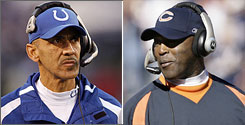
Not only did USA Today spotlight the possible match-up between the Indianapolis Colt’s Tony Dungy and the Chicago Bears’ Lovie Smith, but now that the two teams are officially in, there was even talk about it on National Public Radio this morning and the Birmingham-based Paul Finebaum Radio Network.

I actually sat in my car when I got to the University of Alabama campus this afternoon long enough to hear some of the commentary from callers on the Finebaum Radio Network.

It seemed like Paul Finebaum was dismissing much of the hype about the historical significance – as something more important to older folks who lived in a time when such a match-up between two black male head NFL coaches would have been unheard of.

As a 36-year-old (soon to be 37) African-American male, I can certainly say there is a certain amount of pride that comes with seeing Dungy and Smith on the sidelines. They’ve both accomplished something no other “brothers” have done before.

I don’t have to know either of them to know that somewhere along the way they’ve experienced what I’ve experienced as an African-American male in an unusual or unconventional role for others with my skin color.


The pride in seeing Dungy and Smith is no less than my pride when two coaches at my alma mater, the University of Georgia are mentioned. Athletic Director Damon Evans and Basketball Head Coach Dennis Felton also broke the color barrier in their jobs.

Yes, we can be full of pride while appreciating the time that we’re slowly reaching when these differences won’t matter.

Today they STILL matter. Whether Dungy or Smith’s team wins the Super Bowl, the event in my book is ALREADY a WINNER!

Monday, January 15, 2007

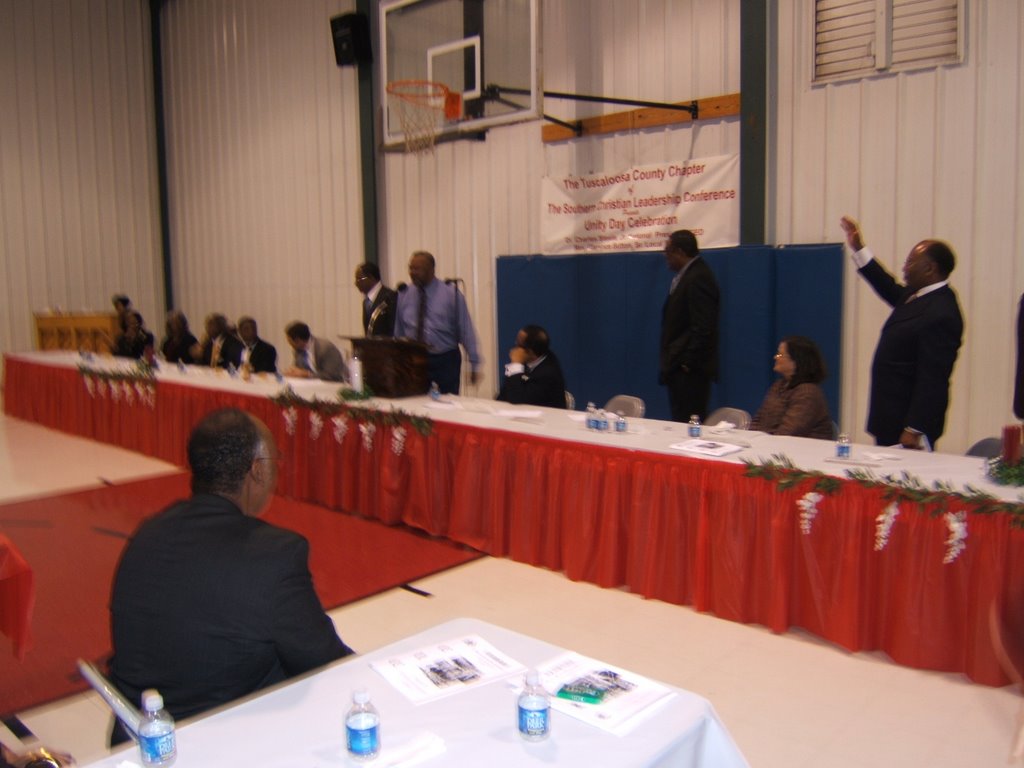
Tuscaloosa Kicks Off King Day 2007


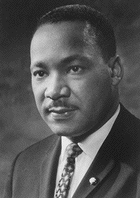
Even though it meant starting out a little earlier than I would normally would on a Monday morning, I managed to get up and arrive nearly on time at a 7am breakfast in West Tuscaloosa in honor of the birthday of Dr. Martin Luther King, Jr.

Coming from Richmond, Va., where Community Learning Week is one of the nation’s biggest celebrations of King’s birthday, second only to Atlanta, I find it hard to believe some people will in good conscious do nothing to mark the occasion.

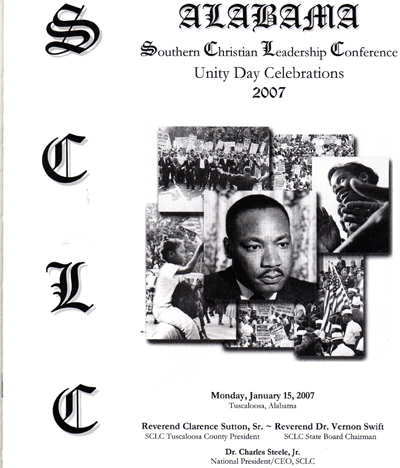
Here in Tuscaloosa, the local chapter of Southern Christian Leadership Conference, which King founded, takes charge of a series of activities known as “Unity Day Celebrations” that in addition to the breakfast, include a unity march and mass meeting.

Before enjoying the breakfast of scrambled eggs, grits, bacon, sausage and biscuits, eleven community leaders and elected officials made quick two-minute greetings to the crowd of more than 300 in attendance.

They included representatives from Tuscaloosa’s three higher education institutions, both Tuscaloosa County and City Schools, the NAACP and the local and state chapters of the SCLC.

One of the speakers noted that today is the first celebration of King’s birthday without either the late civil rights leader and his wife, Coretta Scott King, who passed away last February.

“Mrs. King played a major role in why we’re here today,” said Cordell Wynn, special assistant to the president of Shelton State Community College. Wynn was a member of Montgomery’s Dexter Avenue Baptist Church (now Dexter Avenue King Memorial Baptist Church) when King was the pastor.

“It was always a pleasure to greet her as much as it was Dr. Martin Luther King, Jr. We honor her as we honor her husband”

It’s little tidbits like that from those who step out of history, who knew Dr. King that make attending events like those held today worthwhile for those of us who were not alive during the civil rights era.


As is the case with so many of these events, the majority of those attending were 50 and up. Granted they are in a much better position to recognize the significance of the stock markets, federal and state governments and schools all being closed to honor Dr. King. But, so many more people should acknowledge the only federal holiday named for an African-American.

It’s not only about what happened in the past, but also what’s to come in the future—some of those events here in Tuscaloosa certainly include an element of race—the line that divided so many in the lifetime of Dr. Martin Luther King.

Today locked arm-and-arm singing the familiar civil rights song, “We Shall Overcome,” Tuscaloosa’s black and white residents and dozens of their elected officials ( Police Chief Chuck Swindol and Mayor Walt Maddox, School Superintendents Frank Constanzo, Joyce Levey to name a few) showed how far we have come in crossing that racial divide in this city.

At the same time, many of those speaking reminded those in attendance of how far we have to go.

“I don’t care who disagrees with me. Times aren’t as bad as they used to be. But, we ain’t free,” said Willie C. Jones, pastor of Tuscaloosa’s Bailey Tabernacle CME Church. “We are in troubled times when youth don’t have hope.”

Jones gave the keynote address this morning, which he entitled “Hold On To Your Hope.” He touched on many issues still facing Tuscaloosa today: teen pregnancy, hunger, homeless, violent, lack of black-owned businesses.

This morning’s breakfast was to be followed by a noon-time march from Martin Luther King Elementary School to Tuscaloosa City Hall where Mayor Walt Maddox was scheduled to speak. Then, tonight Tyshawn Gardner, pastor of the city’s Plum Grove Baptist Church will deliver the main address at a 6 p.m. mass rally at First African Baptist Church.

Thursday, January 11, 2007

Ready for King Weekend?

Is it ok to be tired after just one-half week of classes? I wonder because that's about how I feel right now.

Maybe it's the travel back-and-forth to Anniston that's got me whipped. But, these first two days of spring semester have been two L---O----N----G days.


So, while I truly believe Martin Luther King's National Holiday observance is a day ON, not a day OFF, I am looking forward to having the day off from school.

Here in Tuscaloosa, there are several events planned that I hope to experience for myself. While I attend her former church and love her CD, Benita Jones Washington is one gospel artist I have yet to hear. I hope to get that opportunity Saturday at the Moody Music Concert Hall.

Sunday, January 07, 2007

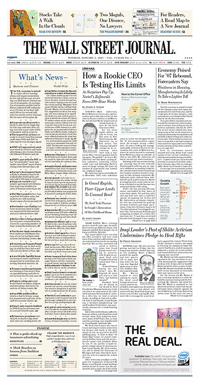
A New Year, A New Semester, New Wall St. Journal

It's January 7th and we're back in Tuscaloosa after a wonderful TWO WEEKS at home in Virginia.

What a whirlwind week it was last week in Washington. It was great to be a stone's throw from all the pomp and circumstance on Capitol Hill.

Now, it's down to business..and I have a lot of it to attend to as we begin a new semester with two courses on media management-- one of my favorite topics.

There's been so much happening on this front over the holidays-- I can hardly wait for classes to begin.

Not only was the AT&T merger with Bellsouth completed, by WHNT-TV in Huntsville and its sister stations from the New York Times Company have a new owner.

The Bowl Championship Series moved from ABC To FOX this year-- with the grand finale tomorrow night in Arizona.


And, then there's the new, smaller Wall Street Journal. I get it everyday here in Alabama, but picked up a copy last week in Richmond. It will take some getting used to.

Tuesday, January 02, 2007

A Saban Note


RICHMOND-- It's not often that the University of Alabama makes the news here in Richmond. But tonight, UA was part of the 6pm sportscast as WWBT-TV NBC 12 reported on the apparent offer made to Nick Saban, current head coach of the Miami Dolphins.

That was old news to me as I've been glued to my parents' computer all afternoon listening to the Paul Finebaum Radio Network as bits and pieces leaked about the coaching search.

I'll admit it, I'm more of a sports fan now that I've been at Alabama-- and even in this land of the Redskins, Alabama football -- or the future of the program-- was high on my interest list.

From the reports in the Sun-Sentinel to a story on the (Louisville) Courier-Journal about Bobby Petrino, I've been monitoring this story very closely at a distance.

We'll see what happens tomorrow.

On A Somber Note


We begin 2007 by marking the end of a life. For me, it's been an interesting last few days.

Today is the National Day of Mourning. But, we've been hearing a lot about Gerald Rudolph Ford since his passing on December 26, 2006.

I only remember Gerald Ford as the guy who was the president before Jimmy Carter. I remember when I was in first grade at Ginter Park School here in Richmond (my hometown) watching the Carter inauguration. (I was just learning what that big word meant)

The whole "Watergate" thing was foreign to me until recently when I really came to understand its significance to journalism.

The kind of journalism that I've seen practiced over the last week is a different kind of journalism-- one that is steeped in historical context.

Our students often ask why we require them to take that two-semester sequence of American history instead just ANY history. It's stories like the passing of Gerald Ford that require a solid foundation in the who's, whats and why's of the past.

As I've experienced this here in at my home in Richmond, I've had the opportunity to talk the things I've seen over with my parents. They've filled in some of the holes.

Much of what you can learn as you watch the televised coverage of the Ford Funerals-- both Saturday's State Funeral at the U.S. Capitol and the National Funeral today at the Washington National Cathedral is enhanced by resources available online.

I videotaped almost six hours of coverage today. Like the Ronald Reagan Funeral in 2005, the ceremony connected with saying goodbye to a U.S. is something we don't experience every day.

Even as I made the short drive up I-95 to Washington for Sunday services at my church there, Metropolitan Baptist Church, I couldn't help but notice all the flags at half-staff -- a site that can be found all over the country, but is much more obvious as you pass embassies, government buildings, and hotels.

Unlike thousands who did file past Ford's casket, which was available for public viewing Sunday, I chose to limit my rememberances to those that were mediated by the electronic and print media.

I'll admit I was not interested in standing in the cold Dec. 31st weather in order to pay my last respects. But, then I just didn't feel as connected to a man who is mostly a figure in history.

At the same time, I downloaded the funeral program today and electronically attended the service at the National Cathederal. It was a mediated experience, but a valuable one nonetheless.

Richmond Marks Emancipation Proclamation

RICHMOND, Va. --Rain, sometimes heavy at times on New Year’s Day is probably to blame for a lackluster turnout at what’s become a tradition for African-Americans in Virginia’s capital city—marking the signing of the Emancipation Proclamation.

The document signed by President Abraham Lincoln in 1863 set in motion freedom for enslaved Africans in many states.

More than 140 years later, the plight of the descendants of those enslaved was the focus of speeches at a worship service at Richmond’s Fifth Baptist Church, which was sponsored by the Baptist Ministers’ Conference of Richmond and Vicinity.

“So often we forget where we came from,” said Herbert Ponder, president of the ministers’ group that hosts the service each year. “Those of us here are charged with sharing this story with generations to come.”

The story of struggle for civil rights, human right and economic rights was recounted by those representing central Virginia’s NAACP chapters, ministerial leaders and elected officials.


“It was just yesterday that we could not eat anywhere our appetites called for,” said J. Rayfield Vines, president of the Henrico County Branch of the NAACP. The civil rights leader questioned whether African-Americans were better people when they were segregated than they are today and “live in the suburbs.”


His comments were echoed by the keynote speaker, Wallace Charles Smith, president of Palmer Baptist Seminary and senior minister Washington, DC’s Shiloh Baptist Church.

In his message “A World Beyond Babylon,” Smith likened the experience of the some Israelites in Babylon in 587 B.C. to African-Americans today, many of whom became too caught up in benefits of their freedom and may have forgotten the role that God played in that freedom.

“Somebody might give you a new name, but remember who you are,” Smith said.

The audience for Washington pastor’s rousing address was much smaller than that which typically fills the first floor of the Fifth Baptist sanctuary.

It was reported that Richmond received as much as three inches of rain on Monday (January 1). As the audience for this service steeped in its traditions of the black church with spirited traditional gospel music tends to include an older demographic, it’s likely the inclement weather forced many to pass on this annual event.

Friday, November 24, 2006

More insights on Gerald Boyd

One of the biggest benefits of the online media is the ability to link and read other insights on subjects of interest. Even after I posted my comments about the death of Gerald Boyd, I learned two other things that underscore my point about Boyd's legacy. They come from those who knew him personally.

1- He was the first president of what today is the Greater St. Louis Association of Black Journalists. I learned that through reading a 2003 column by one of Boyd's close friends from college, editor of the now-defunct Emerge Magazine George Curry.

2- Before becoming managing editor at the New York Times, he covered the Reagan and George H.W. Bush's administrations. In his Gerald Boyd obit, Richard Prince's posting on JOURNAL-ISMS, an online journal about media diversity, includes a link to Boyd's remarks at the National Association of Black Journalists Convention in 2003 in Dallas.


The NABJ website also includes a tribute to Boyd.

The loss of Gerald Boyd


What a shock to awaken this morning to the news of the passing of former New York Times Managing Editor Gerald Boyd.

My first thought was "I didn't know he had been sick."

In reading some of the coverage in today's New York Times and the Washington Post story, apparently, most did not know that Boyd had battled lung cancer for the last few months.

One of the benefits of a web log is that you can type out your own personal thoughts on something while they're fresh on your mind. And to be honest, I'm not sure these thoughts will get lost in everything else I'm doing on this day after Thanksgiving.

As an African-American journalist (now journalism professor), I've been struck by the loss of so many brothers who have made such an impact on our profession.

Some might argue that Gerald Boyd's departure from the New York Times was the biggest loss. But, as you can see and read from his post-NY Times speech at the University of South Carolina and even his presentation a few years ago at the University of Missouri, Boyd took lots of time to contribute to the next generation of journalists.

According to the Washington Post report today, he also had played a role in the development of some courses at the Columbia School of Journalism. So, in spite of the fact that he got caught in the Jayson Blair debacle, he still made a contribution to our profession (present and future) beyond just his own personal achievements.

That's something that is significant.

As journalism educators, we have to make sure to call attention to the legacies of Boyd and Ed Bradley, who also died recently.

Notice I said both Boyd and Bradley. Even with the Jayson Blair scandal, Boyd still leaves a legacy that looms larger than his handling of one failed black journalist's career.

Monday, November 13, 2006

Huntsville from a Different Vantagepoint


HUNTSVILLE-- Usually when I come to Huntsville, it's not to stay very long. This weekend, I made two separate trips to Alabama's Rocket City.

Thursday night Huntsville was my stopover on the route from Piedmont, Alabama to Nashville for the JEA/NSPA Convention.

But, Saturday on the trip back to Anniston, I got the chance to stay in the city's newest hotel-- the Embassy Suites in downtown. It just so happens the place just opened about two weeks ago.


Except for a few glitches with my room key and parking, the place was simply MARV-elous.

Best of all, there was the view of the Tennesssee Valley and the downtown Huntsville skyline that sits down in a bowl...a beautiful bowl.

Sunday morning when the sun finally came out, it was a site to behold. The photo from my hotel window came out ok.

The Podcast Team in Nashville


NASHVILLE-- Before moving on from the wonderful weekend in the Music City, I had to reflect on what I thought was a wonderful workshop on podcasting.

"Pegging the Podcast Potential" was presented at the Fall 2006 Journalism Education Association/National Scholastic Press Association Convention.

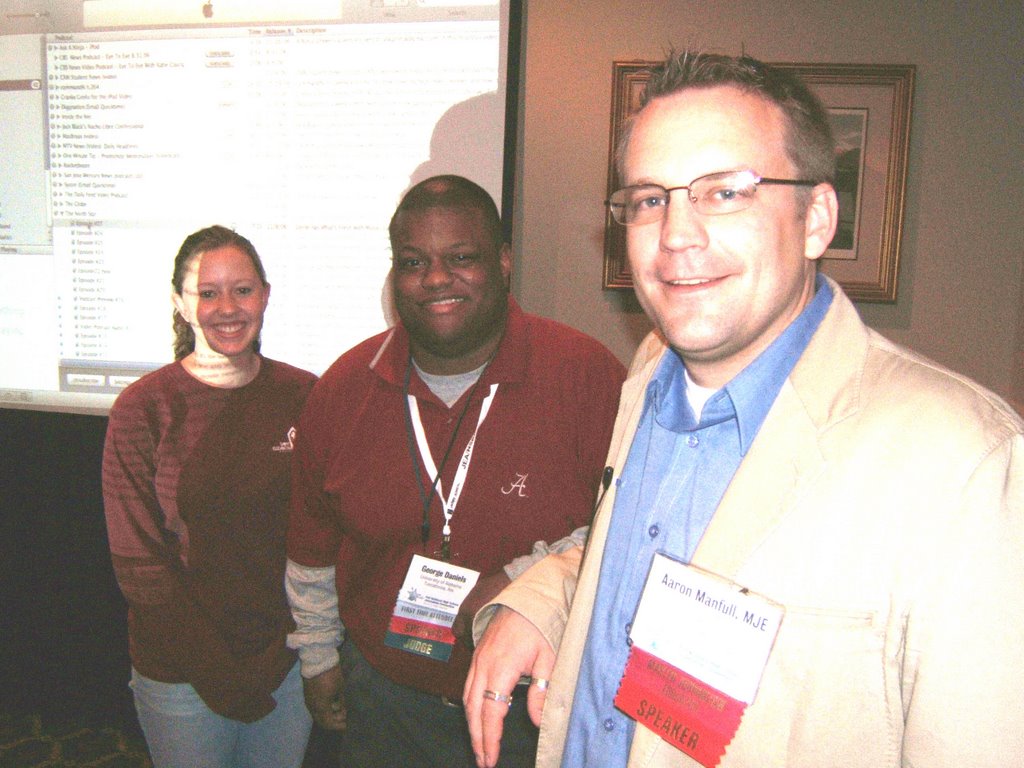
It would NOT have been possible without the hard work and preparation of my expert colleague, Aaron Manfull, a teacher in St. Charles, Missouri.

Aaron and I met last January at the Poynter Institute where the Scholastic Journalism Division of AEJMC (Association for Education in Journalism and Mass Communication) Midwinter Meeting.

In Aaron, I finally found someone who is MORE detail-oriented than I. Down to the order and content of our presentation, Aaron made sure that we had it all planned out.

In reflecting on this experience, I have to say that it was he who made this a success.

In the photo, you'll notice his most able student, Jennifer (whose last name escapes me), who also videotaped the presentation.

It was my first JEA/NSPA convention and my first time working with Aaron. He's a devout Iowa Hawkeyes fan and now a particularly proud Cardinals fan.

What a great weekend!

Saturday, November 11, 2006

George Daniels, CJE

NASHVILLE-- A lot more to tell about what I learned at the JEA Convention. But, with my pin and certificate in hand, I am officially a Certified Journalism Educator.

That's a designation only bestowed until 413 teachers. It's great to be a part of this special group of people who have a special place in their heart for high school and middle school journalism education.

I'll have to write more about this later.

Friday, November 10, 2006

Back in Nashville at JEA


NASHVILLE--- For the third autumn in a row, I have made a trek up to the Music City. This weekend I've joined almost 5,000 delegates attending the Fall Convention of the Journalism Education Association and National Scholastic Press Association.

In all my years of working with high school journalism, I've never seen this many of the young journalists in one place. This hotel is just PACKED with students and their teachers.

The last time I was here at Opryland Hotel was in the late 1990s for a Stellar Gospel Music Awards in December. I had come to cover the Stellar Awards that our Minister of Music, Byron Cage, was receiving. The story would later run in the Christian magazine for which I worked.

This time, journalism is the focus, but the audience is not magazine readers, but students who are learning through their work on newspapers, yearbooks and literary magazines.

In October 2005 and October 2004, I came up to Middle Tennessee State University for the Broadcast Education Association District Meeting.

Like last time here at the Opryland Hote (in December)l is all decked out for the Christmas holidays. I hope to take some photos here tomorrow before heading back South down I-65.

Thursday, November 09, 2006

Baquet ousted


Well, it's a good thing we journalists got a chance to talk with Dean Baquet, now former editor of The Los Angeles Times while we had the chance two weeks ago at the Associated Press Managing Editors luncheon in New Orleans.

When Baquet became executive editor last year, he made The Los Angeles Times the largest American newspaper ever to be led by a black journalist.

During the question-and-answer period at the APME luncheon, I asked Baquet to comment on where he thought the newspaper industry was in terms of its efforts to increase racial diversity. He indicated that he still needed to do a better job of understanding the experiences and perspectives of some of his reporters.

Baquet was let go just months after his publisher, John Carroll (Seen listening to Baquet in photo), was fired by the parent company, Tribune. The two refused to make further cost cuts at the paper that were demanded by the Chicago-based Tribune Company.

He recounted some lessons learned in the experience during his speech to fellow journalists at the APME Convention.

I wonder what he will do now.

Even though I only got to ask him a question in a public setting, I feel like Baquet represented other African-American male journalists like myself who are out there taking on the issue of diversity front-and-center. For him, his stance against Tribune cost him his job.

Still, I believe his willingness to stand on principles will GAIN HIM MORE than he will lose.

Stay tuned for the next chapter in this story.

Loss for Broadcast Journalism


I never got a chance to meet him personally. But, Ed Bradley had an influence on most of us young journalists who wanted to make inroads in broadcasting. This was especially true for African-American journalists.

He proved that an African-American man COULD cover the White House, even if one had never occupied it.

I was at The Anniston Star today when I saw the file photo and banner indicating that he had passed away. Like many of his viewers/fans, I was completely oblivious to the fact that had been ill.

Bradley leaves a legacy of excellence in broadcast journalism that all who tell stories via the electronic media (or print media for that matter) should follow.

He will be missed.

Friday, November 03, 2006

Podcasting Piece Published


Big victory today for a spring semester teaching project on podcasting.

The latest issue of the Broadcast Education Association's correspondence journal, Feedback, has our article containing our preliminary research on podcasting among broadcast stations.

"Pegging the Podcast Potential in the Class and the Newsroom: Lessons Learned from a 2006 Experiment" is a summary of our research both in the industry and in academe.

Bobby Puppione, executive producer of the PROTOTYPE Podcast here at Alabama Public Radio, and I presented the industry research at the AEJMC Midwinter Conference in Bowling Green, OH at Bowling Green State University in February.

Dickie Cox, top guy at the Sanford Media Resource & Design Center, which stored our iPods, also was a co-author on the article.

It's great to see that research in print before the end of this year.

Now, if we can complete the more sophisticated academic research from that experiment. The work continues.

Kirk Franklin's Testimony & Rev. Haggard


I rarely pick up those magazines you see at the supermarket. But, today I have to admit the cover of Gospel Music's Kirk Franklin and wife, Tammy caught my attention.

With all I have to do this evening, I have little time to be reading magazines. But, this particular article was interesting.

It tells a lot about the couple struggles since Franklin revealed his own struggles with pornography.

The story comes out as the nation deals with yet another sex scandal. I think the media's coverage of The Rev. Ted Haggard, who up until this week was senior pastor of the New Life Church in Colorado Springs, has been completely overboard.

It's apparent that Rev. Haggard had some struggles just like most men.

Kirk Franklin's story and Rev. Haggard's story reflect the fact that in the Body of Christ, even high-profile men make mistakes.

For now, the best thing Christians can do is pray for both of these men and their families.

The important thing to remember is God forgives and Kirk Franklin has a testimony to tell. I'm sure Rev. Haggard will have one to tell soon as well.

Quiet Week in Tuscaloosa


After two weeks on the road and two previous trips to Anniston, it was nice to be back in Tuscaloosa for a relatively quiet week.

While I did have a quick meeting in Anniston on Wednesday, I was able to catch up on a few things at home base.

Next, week it's back on the road as we head back to Anniston on the day before and day after Election Day. Then, on the Nashville for the Journalism Education Association Fall Convention.