Saturday, June 16, 2007

Back to Jackson

It wasn't a long trip, but the odometer tells the story-- 389 miles between Tuscaloosa and Mississippi's Capital City.

This time it was a doctoral dissertation defense that took me back to the city.

The re-visit reminded me of the original journey about six weeks ago. In many ways, it seemed shorter than before. This time, I stayed in Pearl, Mississippi where regular unleaded gasoline was 2.78/gallon, some of the least expensive gas I've seen in while.

I topped off my tank before heading back this morning.


While it wasn't my cup of tea, the Jubilee JAM was going on this weekend in Downtown Jackson. This photo of the big crowds was taken earlier today and posted on the Jackson Convention & Visitors Bureau site.

Now that we're back from Jackson, it's time to prepare for Columbia, South Carolina, which comes later this week.

Sunday, June 03, 2007

Six Down, One City to Go


We're back in Tuscaloosa tonight as we complete City #6 on the "Seven Cities, Six Weeks" tour.

I gathered a lot more images in Indianapolis than I've published on this Web log. I hope to have a way to display those shots within the next few days.

As summer school begins this week, our travel opportunities will be decrease significantly.

The seventh city-- also a state capital-- will be Columbia, South Carolina where I will be participating in a Narrative Writing Workshop on the University of south Carolina campus.

Memorable Visit to Indiana Statehouse on eve of big changes


INDIANAPOLIS— From seeing the relatively cozy chambers of the Indiana State Senate to standing behind the speaker’s desk in the Indiana House of Representatives, an unusual close-up view of center for government capped my weekend here in Indianapolis.

Today's visit occurred just a day before new tighter security measures take effect at the Statehouse. When the building opens tomorrow, visitors will have to walk through metal detectors and screening devices that will check for guns, knives and other weapons.

I ran into one videographer from WTHR-Channel 13, the NBC affiliate in Indianapolis, shooting exteriors of the capitol, presumably in connection with this story.

You can read what WTHR has on its site about the story here.

According to the Associated Press, visitors will not be allowed to bring in firearms or other weapons that can cause serious injury, such as certain knives, Taser guns, other stun devices, explosives and various chemicals.

But things were as open as they've been for the last 120 years at what some state lawmakers here in Hoosier State called "the people's building."

Maybe it was the fact that I went to four different entrances before getting to the right one for a Sunday afternoon tour. Since I was the only one in place for a guided view of Indiana Statehouse, I got to ask all the questions I wanted

Austin, the part-time tour guide made sure I knew every interesting detail about the construction of the Capitol, which took almost 10 years to build and was completed in 1888. He provided a great historical view of the stained glass ceiling which sits under the dome, including the manner in which crews keep it clear and why there is so much blue stained glass.

I was surprised at the access I was given to the floors of both houses of the Indiana legislature. Austin just took me right in and I was able to take photos at the front of the Indiana House of Representatives. He even posed for a picture.

Along the way, I learned that this part-time tour guide is a student at Marian College majoring physical education. You might think with all the historical and political trivia that he has to remember to give a tour of the Capitol, he must aspire to be one of those politicians walking the halls.

Actually, Austin aspires to be a high school coach.

After a great weekend attending the Ted Scripps Leadership Institute, it was nice to get outside of the hotel and conference center and see some of Indiana’s capital city.

Even though I walked two of the four floors of the Circle Centre Mall and even picked up a souvenir t-shirt, seeing the seat of Indiana’s state government was the most memorable event of this day.

Friday, June 01, 2007

Finally in Indianapolis


INDIANAPOLIS-- After an unplanned four-hour layover in Atlanta Hartsfield, I finally got on an AirTtran Airways flight to Indiana's State Capital.

I arrived in Indianapolis about 2:45pm, and got to the Leadership Institute about 5 minutes late.

More to reflect on later as I post this evening.

More now, this view of the IUPUI campus will have to do. Gotta go to dinner.

Kicked off AirTran for Taking Notes


ATLANTA-- It’s now 10:27 a.m. I was supposed to be almost in Indianapolis—City #6 on my SEVEN CITIES, SIX WEEKS summer tour. But, I am still in the Atlanta Hartsfield Airport for taking notes on the flight.

Sounds bizarre?

I thought so.

In these jittery post-911 days, flight crews like the employees on AirTran Airways Flight 419 have to be on the lookout for suspicious passengers.

I suppose taking copious notes about my first travel experience on AirTran in almost 10 years could be construed as suspicious.

AirTran has apologized for the inconvenience and given me a free pass for another flight. They’ve re-booked me on an afternoon flight that will get me to Indianapolis in time for the start of the Society of Professional Journalists Scripps Leadership Institute on the Indiana University-Perdue University Indianapolis campus.


But, the bigger story here is that something as harmless as taking notes might get you kicked off a flight.

Fortunately, I as a journalist did not have to surrender my notes and I don’t think I was the cause of the flight being about 10 minutes late taking off. The AirTran Airways attendant who escorted me off said the flight was held up also because they were waiting for ice.

For now, I’m happy recounting the strange experience as perhaps the most memorable event in my “Seven Cities, Six Weeks” tour.

More later.

At least this gives me time to blog about what I experienced getting into the Atlanta Airport this morning. I’ve been gathering elements for that posting.

Thursday, May 31, 2007

Bayou LaBatre, Ala.-- More than Mobile


MOBILE, Ala.-- After a l--o--n---g drive from the northernmost point of Alabama down I-65 to the southernmost point-- Mobile, to Interstate 10-- we are now in City #3 on our "Seven Cities, Six Weeks" tour.

Specifically, I was going to Alma Bryant High School where students there have received a grant from the Radio-Television News Directors Association to bring podcasting to their broadcasting program.

As the author of a soon-to-be-releaesd "Teaching with Podcasting" DVD, I wanted to use Alma Bryant as a place to pilot-test some of ideas for the DVD. Well, I got an eyeful.

First of all, I didn't realize how big the Mobile area really is.

On Sunday, I stayed in Saraland, Ala. before venturing down to Bayou LaBatre (I just learned how to spell that word)

Because of its distance from Tuscaloosa (about 3-4 hours), Mobile is one of the few cities I have only visited a couple of times-- both before I moved to Alabama.

On each of my previous visits, I was enroute to either New Orleans or Tallahassee (long story, I'll explain that one another time).

This time, I ventured well off Interstate 10 down to an area that is right in the "line of fire" so to speak (how's that for a cliche) when hurricanes come ashore.

Alma Bryant is a beautiful high school and folks there were S--O nice. I plan to make a return visit in the fall semester.

As for the rest of the Mobile area, well my second stop of the day was at the Mobile Register, where the Business Editor, K.A. Turner, gave me a quick tour of one of the nicest newspaper facilitiss in Alabama.

My photos are really bad. But, I did get an ok shot of the distribution room where all the Press-Register newspapers are assembled.


All in all, this first visit to downtown Mobile was a quick, but good one.

Later this summer-- in July-- I will go back to the area-- to Orange Beach, Ala. for the Alabama Press Association's Summer Convention. I plan to get some better shots of the newspaper building then.

City #2- Nashville, TN


NASHVILLE-- Even though Nashville is listed as one of those datelines that does not require a state abbreviation, I thought it was important to remind you that I'm in Music City.

I few years ago when I visited Indiana University, I learned there is also a Nasvhille, Indiana There is a Nashville, Indiana located in Brown County just miles from the IU main campus.

On May 5, I made the three-and-a-half hour drive from Tuscaloosa to Nashville for the Society of Professional Journalists Green Eyeshade Awards program. It's one of several opportunities we have to see some of the BEST journalism being produced.

The Green Eyeshade program is a regional competition that involves states in the Southeast.

I'll have to make a separate posting on the ceremony itself. For now, I'll share some of the sites.


The Tennessee State Capitol is one of the first sites I'll share. I didn't get a chance to go inside. But, before leaving town on Sunday, I drove downtown to see the building located on a high hill. This area was a federal fort during the period of Union occupation. The building was completed in 1859.


Also on Sunday, I attended church at Mt. Zion Baptist where Bishop Joseph Walker is the senior pastor. I've been blessed before by Bishop Walker's teaching via the Trinity Broadcasting Network.

It was a totally differenr thing to be in worship with the thousands who are members of his church, which three locations in the Nashville metropolitan area.

You can see from the sign on the church's marquee that it's a church that ministers to all of the needs of its congregants.. even those who are divorced.


After church, I briefly drove through the Vanderbilt Campus, which one of the only two SEC (Southeastern Conference) schools I had not previously visited (the other is in Oxford, Mississippi). Well, actually, I had been to Nashville closeby before-- but it was not as extensive as my trip this time.

Jackson, Miss- The Starting Point


JACKSON, Miss.-- How appropriate to begin my "Seven Cities, Six Weeks" Tour in the Mississippi State Capital. It's the place where a high-profile civil rights case is going to trial.

James Seale is being tried on federal kidnapping and conspiracy charts in the 1964 deaths of two black teens. It is refreshing to see the Clarion-Ledger taking a position on the importance of the trials on its editorial pages.

Not related to the trial, however, my experience making this journey on May 1 was to visit the campus of Jackson State University.

I am fortunate to be serving on a doctoral dissertation committee for a student at Jackson State. It's not only a chance for to see this colleague complete her terminal degree, but also a chance to visit another historically black college or university.

As a product of an HBCU (Howard U.), I have a special place in my heart for these schools that educate more African-Americans than any other institution for careers in journalism and mass communication. Today, Jackson State University has the nation's only E-Ph.D. or Executive Ph.D. program in urban higher education.

That's where I visited on May 1.


I didn't walk the grounds of the main campus. Instead, I spent most of the day at the Jake Ayers Institute for Urban Higher Education, which is in the same building as the University's TV station, TV 23.

I got to tour the facility and speak with one of the production assistants who shoots and edits local content for the station, which up until recently aired programming from the Black Family Channel.

After meeting on the JSU campus, I ventured downtown to see the Mississippi State Capitol. Unfortunately, time did not permit me to go inside to see the hub of Mississippi's state government. But, at least I know where it is -- just off Interstate 55.

City #5- Atlanta, Ga.


ATLANTA-- Tonight we end the month of May as we began—on the road. I never posted my updates from City #1, City #2 or City #3 on the Seven Cities, Six Weeks Tour. (That’s coming, I promise) But, it all began May 1.

City #5 is Atlanta, Georgia.. another state capital. That makes THREE State Capitals I’ve visited (four if you include one I drove through) within the last 30 days.

The important components of these visits are the sites, sounds and the experiences. Since I’ve lived here before, Atlanta is not really a visit. Instead, it’s a reunion.

There aren’t many sites and sounds to take in from Interstate 20, which is about all I have seen today. (We’ll see how bad morning traffic is tomorrow)

The occasion: taking a flight on AirTran Airlines or is it AirTran Airways? I’ll have to check that out later.

I usually fly either Delta or Southwest Airlines. But, this trip to the Society of Professional Journalists Scripps Leadership Institute is being funded through the SPJ Headquarters, which uses a travel agency.

These days many of us have become accustomed to air travel with electronic tickets—the ones that are e-mailed to us and we check-in online printing our own boarding passes.

Well, when you use a travel agency, you have to get a paper ticket. So, I’ll have to go through the old-fashioned check-in with my paper ticket tomorrow morning at Atlanta’s Hartsfield Airport, which just celebrated the one-year anniversary (a term that is stylistically incorrect according to the latest Associated Press Stylebook) of its newest runway.

So, greetings from Georgia’s Capital City—the former Olympic City—Atlanta!

Wednesday, May 16, 2007

City #4- Chicago- A Day At Navy Pier


CHICAGO- The 3:30 a.m. wake-up was necessary to visit the Windy City in a day and still come back to Tuscaloosa.

We landed at Midway Airport by just about 8:15 a.m.

The cab ride from Midway to Navy Pier was a not a short (or a cheap) one-- a $30 one at that.

And than, there's Navy Pier- HUGE- JUST HUGE! I made the mistake of coming in the wrong end of this attraction and we walked and we walked and we walked all the way to the other end of the Pier-- the more scenic end where 500+ people were already in place for the Adobe CS3 Creative License Conference.

This above photo was taken from the other side of the room where more than 500 people turned for the first in a series of one day conferences. The photographer, Terry White, wrote more about today's conference on his blog.

He was the main presenter at the conference, about which I'll write more later.

Tuesday, May 15, 2007

Summer Travel Log Begins


Even though it was TWO weeks ago today that I began a seven-city swing to places in the eastern United States, I am just getting around to starting my online journal of what I learned from each of these places.

As the rough artwork depicts-- I'm calling this "SEVEN CITIES, Six Weeks" as a way to tie together what I expect will be a long series of postings.

My goal is to present in a multimedia fashion, a series of reports, updates, lessons learned, reflections, etc on my experiences in the places to which I travel between May 1 and June 23, 2007. (Yes, technically that's a slight bit over six week-- but you get the picture).

Starting on Tuesday May 1, I visited the Westernmost city on the tour-- Jackson, Mississippi. That was followed on May 5 with a stop in Nashville, Tennessee. Then on Sunday May 6, I arrived in Mobile, Alabama.

Tomorrow, May 16, I will be back on the road again for a one-day excursion to the Windy City of Chicago, which will be followed roughly two weeks from now to the Indiana State Capital-- Indianapolis on June 1.

In between Chicago and Indianapolis, I will make a very brief stop in the Georgia capital city of Atlanta.

The Seventh and final city on the schedule is Columbia, South Carolina. Yes, there will be worthwhile points in between to mention. My datelines will let you know the places from which I was filing.

You'll notice in the list of stops are visit state capitals. I hope to visit the actual state capitol in the state capital while I am there.

The experience of blogging over this period of time is teaching me just how difficult it is to keep an online journal-- keep it up, update it and present different content that is interesting and compelling to read and enjoy.

Why do we do these travel logs? What is the benefit of multimedia journalism? And, what does providing this kind of insight do to the reporting experience? Those are some the questions I hope to answer as I go along this personal summer journey.

On some legs of this trip, I'll have postings with a timeline to share as I make the more interesting aspects of the trip real -- while on others it will be a traditional journalistic endeavor of writing a story that has an interesting hook or compelling lead or exciting quotation.

The dates of the postings may not necessarily correspond to the day the trip was taken. That's all a product of where I am and the nature of the computer access I have along the way.

Well we have an early start tomorrow-- with a 6:40 flight from Birmingham. So, we'll call it a night.

Friday, March 30, 2007

Watching the Web from the newsroom


GAINESVILLE, Fla.-- It's been a while since I've posted ANYTHING on this Weblog. Guess a month has passed. Well, let's see spring break -- travel back home to Virginia, back to Tuscaloosa and a big research paper deadline -- which is this weekend-- those activities will kind of eat up the time for blogging.

Even as I finish up the research paper(s), it's great to be back in the Sunshine State of Florida. I've posted a more extensive DAY 1 update on the Society of Professional Journalists Conference on my COMJ Exchange Blog. But, I thought I'd show off this giant HD monitor that I saw in the newsroom of The Gainesville Sun.

Perhaps it is a sign of the times as reporters and editors at the 50,000 circ paper monitor their paper's Web site and several others like the Arizona Republic's site -- which integrates the converged media efforts of Gannett's highly successful daily in Arizona and its Phoenix TV station, KPNX- 12 News.

More fun stuff from Gainesville as we visit the University of Florida campus tomorrow morning.

Sunday, February 25, 2007

Experiencing Northern Nevada


RENO, Nev-- As I've posted over on my comjexchange blog, I'm in Reno, Nevada today finishing up a four-day visit to the nothern part of the silver state.

This photo hardly tells the story.

More later.

Saturday, February 17, 2007

George Curry heads to Tuscalooosa


After being here in Tuscaloosa for four years, I am finally going to meet one of the town’s most well-known native sons.

George Curry, editor of the now-defunct Emerge magazine, is coming back to speak at the University of Alabama on Monday.

I’ll say this particular visit is one I had hoped we would have years ago when George and I exchanged e-mails right after I moved here from the University of Georgia.

Curry was candid about the history of Tuscaloosa and the lines that in the past have sometimes divided its residents.

His insight gave me a context to understand the recent debates over the location of the new Central High School.

In many ways, Curry and I have had similar paths—not just as journalists or black men who’ve lived (and I assumed loved) being in the nation’s capital. And, not JUST because we both have the same first name.

Back in his days at the St. Louis Post Dispatch, Curry was instrumental in reaching back to high schools. He was the founding director of the St. Louis Minority Journalism Workshop. He subsequently started a similar workshop in Washington, DC.

I frequently sing the praises of these Dow Jones Newspaper Fund workshops because of what I know they do for diversity in the newsroom and specifically for the role one played in my own life.

Of course, just yesterday, I commented on the recent court decision involving the Dow Jones Fund’s use of name “minority” in those workshop names.

Curry realized as I have that as African-American journalists, we have a responsibility that goes far beyond getting the story or putting out a newspaper or television show.

He remembers the role journalists can and should have in making a difference—a lasting difference.

Just ask one of my home girls, Kemba Smith, whose minor role in a drug ring while at Hampton University landed her in prison because of the federal government’s “mandatory minimum” drug policy. With a brother at Hampton University, this story was one in which I had a lot invested. The Smiths were a big part of our community in Richmond.

I could go on and on about why George Curry is one of the best in the business.
In the pre-Viacom days when Black Entertainment Television was owned and run by Bob Johnson, there was a program called “Lead Story,” that featured African-American journalists talking about issues in the news for the week.

Seeing Curry, who now runs the National Newspaper Publishers Association and BlackPressUSA.com, on that show was how I got to know this native of Tuscaloosa.

After Black Entertainment Television became part of Viacom, it was not long before the public affairs programs like Lead Story were canceled.

Richard Prince’s JOURNAL-ISMS recounts more about what happened.

Curry, in fact, commented on the decision to kill not only Lead Story, but also two other public affairs programs in a story on his NNPA News Service.

“An African-American company gains a considerable amount of capital when it sells out to a powerful conglomerate,” said Curry, who was a panelist on “Lead Story” for more than seven years. “But it also loses something important. Regardless of how BET tries to spin it, the loss of these important programs represents a major setback for the Black community.”

Curry has tried to resurrect Emerge magazine, which went under in 2000. I hope on Monday we’ll learn more about those efforts and what he’s doing at BlackPressUSA.com.

Friday, February 16, 2007

Fed Court: Open up minority journalism workshops

It is official: if you’re white and can prove that your race is the only reason you’re not being allowed to take part in a summer journalism program at an academic institution, you can sue and force the institution to admit you.

Yes, the way I’ve stated this is a little inflammatory. But, for good reason. Fortunately, civil rights laws don’t allow discrimination based on one’s race in any scenario.

Last summer, Virginia Commonwealth University clearly erred in disinviting a white student who had been admitted to its Urban Journalism Workshop allegedly because the workshop organizers learned she was not a minority student. Read more about the case in this story from the Commonwealth Times.

The Chronicle of Higher Education reported this week that ”the Dow Jones Newspaper Fund agreed to cease operating summer journalism programs solely for minority students.”

Since when has Dow Jones been operating any programs solely for minority students?
While focused on increasing the presence of racial minorities in the nation’s newsrooms, the Dow Jones Newspaper Fund has never PROHIBITED a non-minority student from taking part in the workshops it funds.

Up until now, as a private organization, it could encourage those organizing the 10-day or two-week summer programs often held on public university campuses, to do targeted recruitment aimed at students of historically under-represented racial groups.

According to The Chronicle, “Dow Jones agreed to open up its programs to
members of any racial or ethnic group and to rename the programs to drop
references to minority members.”

The language (i.e. “open up) used in this story assumes that the programs had been closed or exclusionary. It even listed my institution among those that were “involved in the race-exclusive Dow Jones programs last summer.”

If you click here, you will see the photos of some of our students in the 2006 workshop at the University of Alabama . I remember getting to know Nick Persac as we sat together at the opening night banquet as the legendary Merv Aubespin socialized this group of outstanding young journalists into the intensive experience of a Dow Jones workshop.

Nick ended up enrolling here at Alabama for a semester. But, he was not part of a “race-exclusive program.” We don’t run such programs here at the University of Alabama.

Here at the University of Alabama, we renamed our workshop, which is now in its 24th year, several years ago. Since 2003, when we began calling our program the Multicultural Journalism Workshop, we’ve had several outstanding white students like Nick to apply and be admitted to our program.

I know this much because as a co-director of the 2004 workshop, I made the visits to high schools inviting students of all races to come and experience journalism for two weeks at one of the nation’s premiere journalism schools.

I feel a special connection to this whole Dow Jones controversy because I credit the Urban Journalism Workshop at Virginia Commonwealth University with being the SINGLE turning point in my decision to pursue a journalism career. I have to wonder if a white person had sued to force his or her admission into the 1986, would I as an African-American male have had a chance to get turned on to journalism?

I think the answer is “YES.” I had been diligent enough during my freshman and sophomore years in working on my high school newspaper and yearbook and was a strong enough student academically that I would have been admitted regardless of whether white students were in my program.

The point is—this is not about keeping students from any racial group out of a summer journalism experience like the Dow Jones workshop. It’s about how far some will go to push their political agenda under the guise of “Individual Rights.”

The real issue is not one person’s individual rights, it’s the effort to the nation still needs to make to go out of its way to diversify our nation’s newsrooms. The latest figures from the American Society of Newspaper Editors the percentage of minorities working in newsrooms is still only 13.87 percent.

Organizations like the Center for Individual Rights don’t seem to be concerned about that.

“Today's [Feb. 15] settlement saves the taxpayers significant legal expense and
ensures that this summer's programs will be open to all, regardless of
race," said Terence J. Pell, president of the Center for Individual Rights.

Thanks Center for Individual Rights for reinforcing what many Dow Jones Newspaper Fund workshops already do. Now, what about that 13.87 percent of minorities in newspaper newsrooms? How do we increase that number now?

Assuming, everyone has a RIGHT to participate in a Dow Jones Newspaper Fund workshop, where are the funds to increase the number of seats so that the Dow Jones program can have at least equal the impact it has had on the industry during the last quarter century?

The struggle continues!

Tuesday, February 13, 2007

AJC editor: Blogs don't offer "core knowledge"


The irony in this web log is sometimes the postings speak against the very medium that I am now using to disseminate information, the web log.

The number-two man at one of the nation’s largest newspapers questions the public’s reliance on what we say on Web logs.

Hank Klibanoff, managing editor of The Atlanta Journal Constitution, was in Tuscaloosa Tuesday to sign copies of his new book, The Race Beat: The Press, The Civil Rights Struggle, and the Awakening of a Nation. Here's a review of the book.

Along with calling for journalism professors like myself to focus on teaching the core values of the news-producing medium, Klibanoff questioned just how much stock the public puts in what it reads in the so-called blogosphere or what people read on web logs like this.

“The American people will not accept that as core knowledge they need to make decisions,” Klibanoff said.

It was an interesting take on the role of journalists today, which Klibanoff said must be produced by journalists who “write what they see” and aren’t afraid to hold those in government accountable and to “challenge the obvious.”

Klibanoff’s book signing coincided with the opening of a new exhibit at the W.S. Hoole Special Collections Library on the University of Alabama Campus.

“They Came.. They Saw.. They Reported: Images from the World Press Coverage of Segregation’s Last Stand” focuses on the storytellers of the 1963 event for which Governor George Wallace is most remembered.

The photos were taken by UA Professor Emerita Camille Elebash, who witnessed Autherine Lucy’s attempt to role in the University in 1956. Elebash’s photos were published in The Graphic, “Tuscaloosa’s County’s Home Newspaper”

Thursday, February 08, 2007

From occasional blogger to Power blogger?

I've lost an hour (time I was supposed to working something else) reading through and digesting a posting on another blog about the so-called "Power blogger."

Thanks to fellow blogger and journalism professor Anthony Moretti for the tip.

How is a power blogger defined? And, what makes one blog better than another?

In this article, 12 Posts a day was mentioned-- posting constantly and finding a particular niche.

Last year, I was good if I made 12 posts in a few months' time.

Guess I haven't fully embraced the technology. In order to make a dozen posts in one day, one really has to be almost a full-time blogger like Romanesko whose multiple posts are read by dozens of journalists.

In the process of reading about Power blogging, I just learned that Mark Whitaker has moved from the role of editor-in-chief of Newsweek to the chief of new ventures for The Washington Post.

It's all one big company (Washington Post Company), but this clearly appears to be a real future-looking transition for Whitaker.

He was interviewed by BEET TV at the recent Always On conference.

"The future of journalism whether it's in print or online is everybody figuring out where they add value," said Whitaker.

Based on this statement, I have to ADD value when I'm blogging if this is part of that forward-looking journalism that I'm trying to teach in my classes.

Whitaker described the fact that so many news organizations in the U.S. report the same stuff and thus, add little to the public's overall understanding of an issue or event.

Power blogger? No, not anywhere close. But, adding value-- now THAT's something I think I can do.

Saturday, February 03, 2007

Bush visits my home state


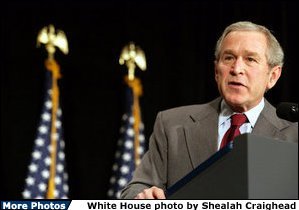
It was kind of neat to know that the President of the United States was in my home state today-- not that the White House is that far from Virginia.

I'm looking forward to returning to Richmond for spring break in a little over a month from now. Trouble is, I'll miss all the political fun that those who like to watch the political scene get to engage in when in the former capital of the Confederacy.

During our winter break, we got to read about, be close to the political changeover in Congress.

I miss a lot that working here in the deep South. Alabama has it's own quirks and qualities, but there's no place like the Old Dominion. I miss it and can't wait to get back next month.

Oh yeh, this posting was supposed to be about President Bush visiting Williamsburg. I just read the Associated Press story on the Virginian Pilot's Web site.

Guess I'll have to tune in to C-SPAN to see what else happened in Williamsburg today.

Terry Moran vs. a talking head

My latest analysis of Terry Moran's Web log actually brings to mind a point about the difference between what are often called "talking heads" and a working journalist like Mr. Moran.

If you look at the postings on Moran's web log, you can see serious commentary as he is drawing on his experiences as a journalist, not just spouting off his opinion (as I guess I'm doing on this blog).

In fact, Moran is very careful to leave his opinion OUT Of his web log. Instead, providing just enough depthy (an academic term that says more than "deep") analysis to provoke a reader's response.

This week I've been struck by the discourse on the two black Super Bowl coaches and in particular, the programs on some of the cable networks.

Originally, I was going to do a follow-up posting on that subject, which I addressed a few days ago. But, when I downloaded the transcripts of some of these shows and really read through them, I was unimpressed.

Earlier this week, I had a chance to chat with a recruiter/instructor from the Columbia School of Journalism. She was lamenting the idea of talking about blogs when she's read so many uninspiring blog postings of some of her students. We were chatting about whether blogging ought to be incorporated in our journalism instruction.

I've based my own enthusiasm for this medium on the great things I've read on journalists' blogs and opportunities I've had to report on things I've witnessed, often on events the local media won't cover.

That said, I see that often these talking heads on the cable network shows have very elaborate Websites promoting their books, media appearances and on-air ventures. But, their postings and on-air comments are uninformed, superficial and often not worth my time.

I guess I should just turn the channel right? Well, it's not that easy.

If the discussion is on a subject about which I care a great deal, I want to see people engaging on the subject who have done the research and are well-informed on the subject.. not just there to debate the other side and then go home.

I suppose the reality here is that those talk shows are designed primarily to showcase the extremes in a debate, not provide substantive insight on key issues of the day. For that, I have to go to my fellow journalists, who instead of telling us what to think, tell us what IS and WHY it IS. Then, the rest is up to us.

Before we as journalists (working and semi-working) and journalism professors totally embrace Web logs as a news medium, we have to take a more critical look at what's being offered online. I think that's what I tried to do with Moran's blog.

Perhaps this process goes without saying.

I think it might be worth a mention.

Update on Terry Moran's blog


Well, after a couple of weeks, ABC News' Terry Moran’s online musings are growing on me.

The web blog is called PUSHBACK and it's giving ABC viewers and interested parties additional access to thoughts of this network news anchor/reporter.

Based on previous experiences with ABC News, I was quite skeptical of Moran's move into the blogosphere in an earlier posting.

While he is not engaging with every individual posting, he is reading the feedback and using that as a springboard for further postings.

That’s the challenge with this blogging thing-- what do you write about every day? It’s no different than having a regularly-published newspaper column.

During the month of January 2007, I’ve been posting more to this web log than I did all of last year (2006).

What did I learn from reading back through Terry’s postings today? Well, for one, I picked up on a story I missed about a New York Times reporter who was reprimanded.

That’s definitely an example I’ll use in my journalism class this week. I learned a lot more about War Correspondent Ernie Pyle, about whom I previously knew very little. (Yes, I’ve heard for Ernie Pyle before and been to Ernie Pyle Hall, home of the Indiana University School of Journalism).

So, I think Terry’s pricked my curiosity enough to keep reading his blog and adding to my own.

I’ll admit I didn’t watch ABC Nightline at all last week. Ultimately, that’s why the news networks are encouraging their staffers to enter into the blogosphere. They want to drag interested parties back in front of the TV to watch their shows. It’s a strategy that certainly works on me.

So, Terry Moran, in case you’re reading this—I like the blog, so far!